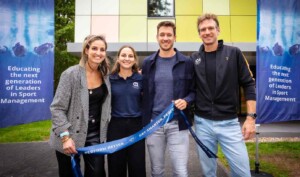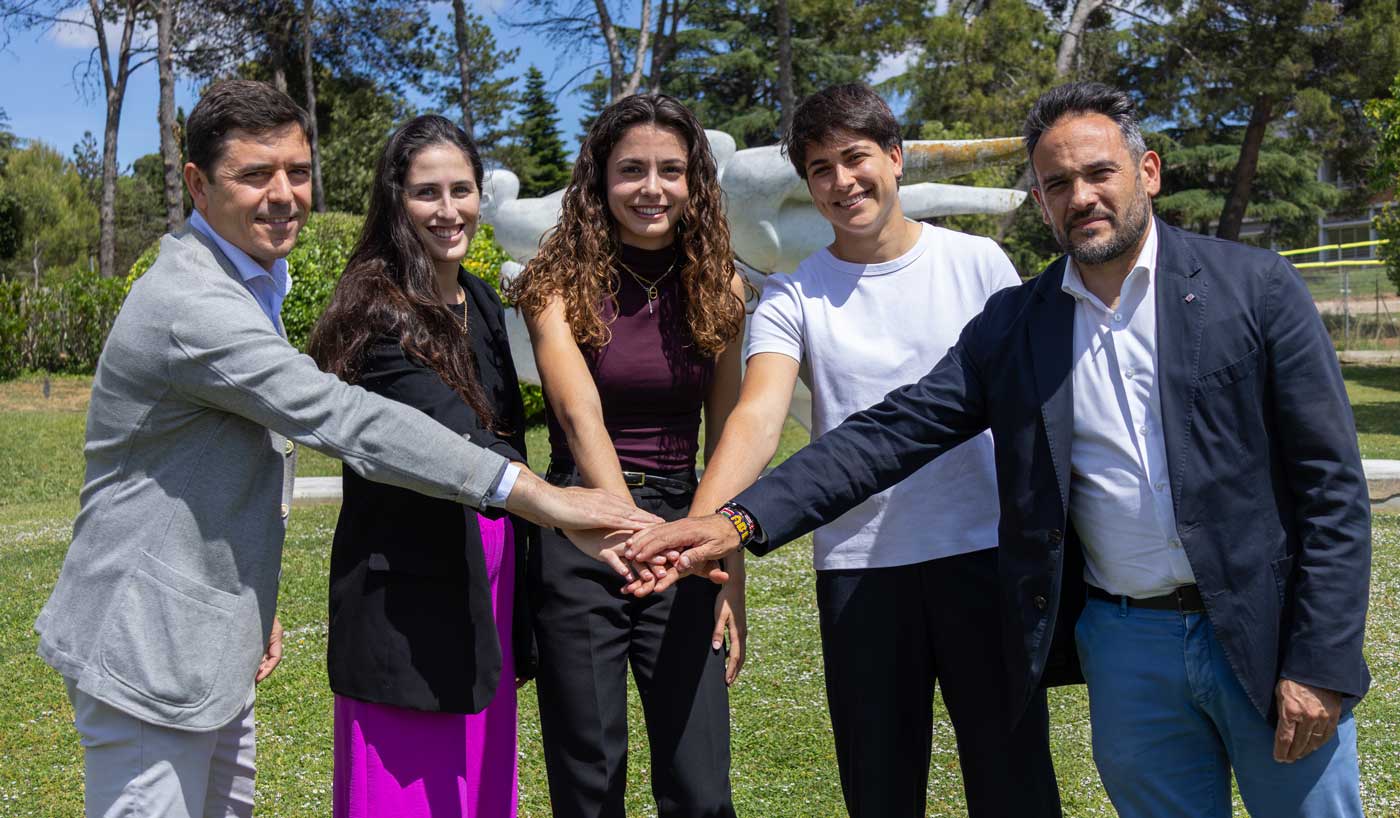
Blanca Toledano, Andrea Medina González and Clara Pérez Calderón, three athletes from the Centro de Alto Rendimiento (CAR) of Sant Cugat del Vallès and students at Johan Cruyff Institute, share their experience of building a dual career that combines elite sport and education.
The scholarships that the Johan Cruyff Institute offers each year to athletes from the CAR are linked to Johan Cruyff’s vision of advancing the sports industry through professionals who pursue a dual career, combining competitive experience with a solid academic background. For athletes, they represent an excellent opportunity to take the next step in their careers.
The stories of Blanca Toledano, Andrea Medina González and Clara Pérez Calderón are a clear example of this. All three have enjoyed outstanding sporting careers and chose to pursue academic training alongside their athletic development.
 Blanca Toledano is a Spanish artistic swimmer renowned for her international elite career and her participation in the Tokyo 2020 and Paris 2024 Olympic Games.
She currently works as a coach for the Royal Spanish Swimming Federation. She studied the Master in Sport Marketing and Management Blended Barcelona.
 Andrea Medina González is a former Spanish modern pentathlete who represented Spain for more than seven years in international competitions organised by the UIPM, including the qualification process for the Paris 2024 Olympic Games.
She studied the Master in Sport Marketing and Management Blended Barcelona.
 Clara Pérez is a Spanish field hockey goalkeeper, a member of the senior national team and Atlètic Terrassa. She competed in the Paris 2024 Olympic Games and was crowned European Under-21 Champion in 2019.
Clara studied the Master in Sport Business Online.
In this interview, Blanca, Andrea and Clara explain what it was like to balance their sporting careers with academic studies, what life in high-performance sport is like, and the kind of projects they would like to pursue in the future.
At what point did you decide to study while developing your sporting career?
– Clara
I don’t think I ever considered not doing it. My parents always encouraged me to study, and I’ve always enjoyed learning. There was a period when I wasn’t sure how to balance everything, but when I arrived at the CAR, the Athlete Support Department helped me a lot. They explained the different options available and encouraged me to continue studying. Sport eventually comes to an end and, in my case, because it’s a semi-professional sport, I can’t dedicate myself exclusively to it. That’s why I believe dual careers are so important for athletes.
– Andrea
Like my fellow athletes, studying alongside competition felt completely natural. Education has always been important to me. From a young age, I was taught the importance of developing myself beyond sport. Thanks to the CAR and Johan Cruyff Institute, we can continue studying and build our professional careers outside the sporting arena as well.
– Blanca
Yes, I share that view. For us, it wasn’t really a choice; we simply knew we had to study because all three of us compete in minority sports. It’s very important because we know that a sporting career has an expiration date.
“We’re very fortunate to be here, to receive support from the CAR and the Athlete Support Department. We’re very happy and learning a great deal at Johan Cruyff Institute”.
Do you have any routines or tools to manage pressure before or during a competition?
– Blanca
For me, it’s very important to remember that what we do in competition is exactly what we train for every single day of the year. Our sport comes down to three minutes in which you have to demonstrate everything you’ve practised, perhaps for ten hours a day. That’s why it’s essential for me to step out there knowing I’ve repeated it so many times that I’m capable of doing it.
– Clara
In my case it’s different, because it’s not about repeating a routine but competing in a match. I try to focus on enjoying it and remembering that every detail matters.
“I think my best performances have been the ones where I’ve enjoyed myself the most”.
– Andrea
In my sport, having a routine and focusing on the process rather than the final result was very important. I believe it’s essential to have all the steps clear in your mind and concentrate on one thing at a time, moving forward gradually until you achieve your goal.
Did you find it difficult to build an identity outside sport?
– Andrea
I wouldn’t say it was difficult, but after so many years practising a sport, it can feel as though your entire identity revolves around it. However, because I always knew I wanted to develop myself in other areas, I never saw it as a challenge but rather as an opportunity to get to know myself better and open myself up to new experiences.
– Blanca
In my case, I retired last year and now work as a coach here at the CAR. Regarding identity, I think that over time you develop your personality as a person, not only as an athlete. You’ll always be an athlete, even when you’re out of the water or no longer involved in sport. Throughout these years I’ve built that identity, which I can now bring into my work as a coach.
– Clara
For me, it was a little more difficult. I had to step away from elite sport and later return because I felt I wasn’t being myself. I had the impression that people valued Clara the goalkeeper more than Clara the person. I spent around two and a half years away from elite sport and high-level competition, though not away from hockey itself. That time helped me understand who I was, what I enjoyed and what I wanted to become beyond sport.
Recently, I’ve also started working more on my social media presence, and having a clear sense of who you are helps you present yourself to the world. Judging by the feedback I receive, I think I’m managing to convey that, and that’s very important too.
What type of career or professional project would you like to develop in the future?
– Clara
I’m using my master’s program and final project to explore the possibility of creating a field hockey academy for goalkeepers. My goal is to understand whether it’s a viable project, because hockey is a very popular sport in my city and I believe the goalkeeper position doesn’t always receive the attention or resources it deserves from clubs. For me, this project is a way of exploring a potential professional path.
– Blanca
The master’s program is helping me explore a different field because I’m actually a psychologist, so it’s not directly related to my previous studies. I’m really enjoying discovering new areas and, above all, meeting people like Andrea, since we’re working together on our final project. It has allowed me to discover a completely different world. Looking ahead, I’ll probably pursue another master’s degree more closely related to psychology, but exploring other fields is opening many doors for me.
– Andrea
“I think the Master in Sport Marketing and Management Blended Barcelona has helped me combine my two worlds”.
I completed a degree in Business Administration in English last year, and this transition between being an athlete and entering professional life is teaching me a lot. Although I’m still not entirely sure what I want to do in the future, I know I’d like to remain connected to sport in some way. In that sense, this programme has been incredibly helpful.
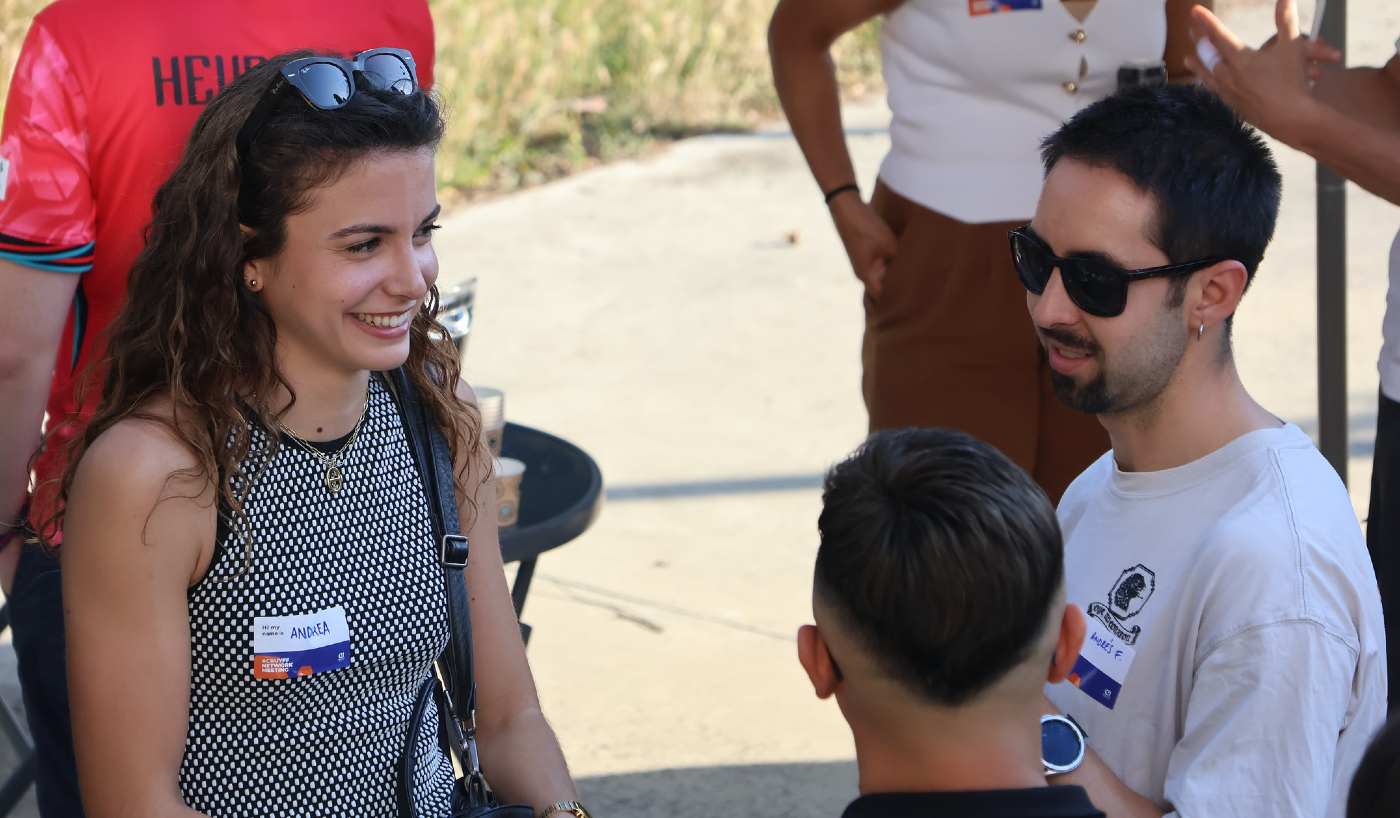
Andrea Medina González is a former Spanish modern pentathlete who represented Spain for more than seven years in international competitions.
What advice would you give to an athlete who is considering studying or training alongside their sporting career?
– Blanca
I think all of us are very clear on this: don’t hesitate to do it. Sport comes to an end one day and, except in very rare cases, education is essential. It not only prepares you professionally but also helps you grow as a person and build your identity.
– Clara
Exactly because a sporting career has an expiry date, whether we like it or not. Very few athletes can sustain it for many years.
“Education doesn’t just help professionally; it also provides tools that can be useful in sport itself”.
– Andrea
I think my teammates would agree with me. It’s important to have motivations beyond sport and activities that allow you to switch off. Constantly thinking about training and competing isn’t healthy from a mental perspective. That’s why I believe it’s essential to have a second path that helps you disconnect, keep learning and discover new interests.