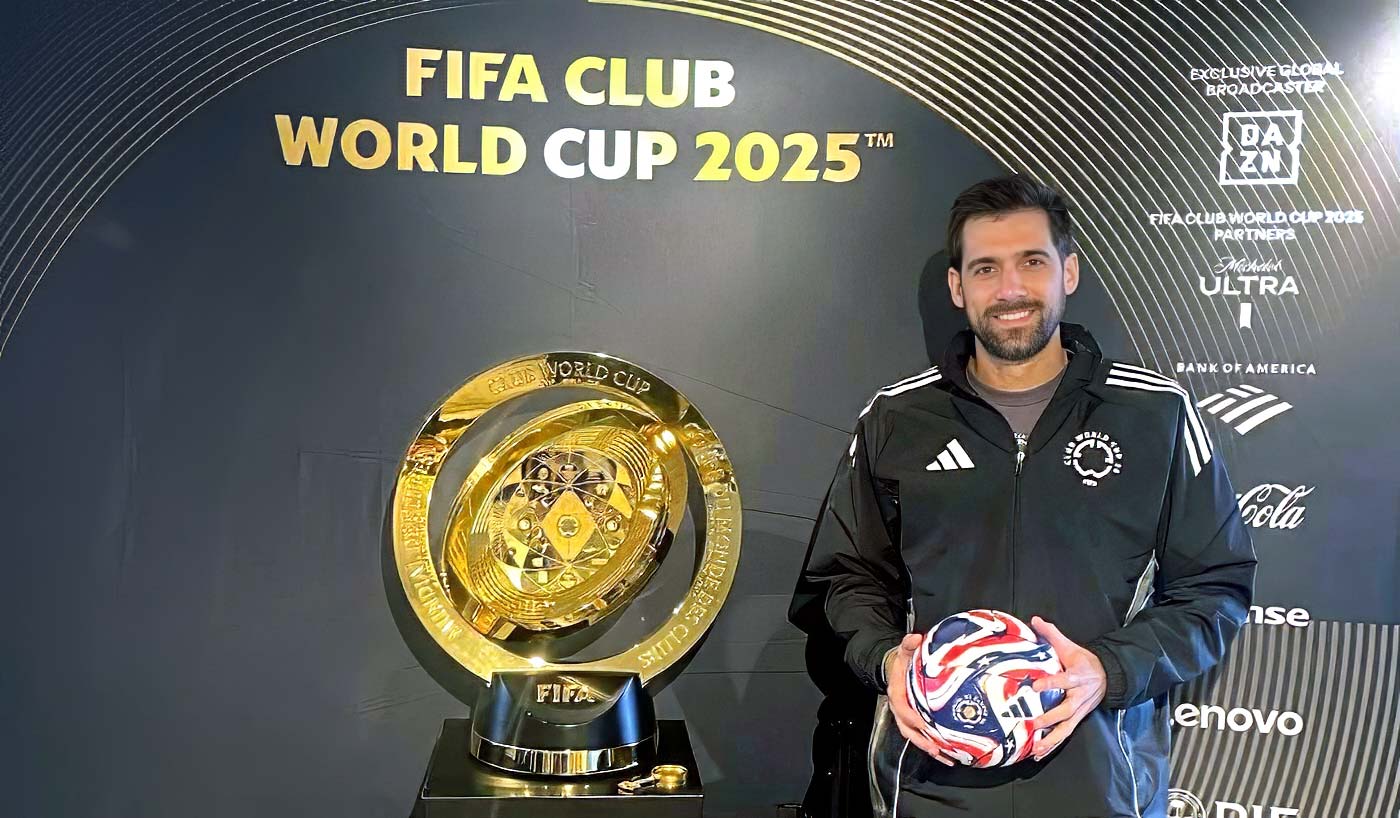
Adrià Carrillo studied the Postgraduate Diploma in Sport Marketing and Sponsorship Online at Johan Cruyff Institute and currently works on the organization of the FIFA World Cup 2026 as Media Partnerships Relations Manager
Although he is from Barcelona, Adrià Carrillo’s professional career led him to live in Australia and now in the United States, working on media partnerships for FIFA World Cup 2026. An alumnus of the Postgraduate Diploma in Sport Marketing and Sponsorship Online at Johan Cruyff Institute, Adrià highlights social skills and communication abilities as key to working in the partnership sector.
In this interview, Adrià reviews his professional career, which also includes MotoGP, and shares insights and advice for those looking to work in the sports industry.
What was your professional and academic journey like until you reached your current position as Media Partnerships Relations Manager?
Well, it’s been a journey, a long path. If I had to define it in one word, I would say it was unpredictable. When I was younger, when I started studying in high school and university, I wasn’t very aware that this type of job even existed.
Obviously, you know that sports competitions like the World Cup exist, but you’re not aware that there are many people working behind them who dedicate themselves to that. You only see the athletes; you don’t see the people behind the scenes.
So I was never aware of it, and it was never a decision. It’s true that I have a passion for sports; I’ve always liked sports a lot.
“My life, somewhat unconsciously, has always revolved around sports. I guess that’s why I feel life has brought me to where I am, even though I never consciously chose it.”
I lived in Australia for a while, and that’s where I started working at an events agency and began having my first professional contact with sports. Being at sporting events, rugby matches, football matches. Then I returned from Australia, where I spent four years; I went back to Barcelona and found a job at Dorna, in MotoGP. I think that was the confirmation that it was possible to work in the sports industry and that it was my place.
Now, in your current role, what are your main responsibilities and what kind of strategic decisions are part of your daily work?
“I work in the Media Partnerships department. We are responsible for maintaining all relationships with all broadcasters, with all international and national television networks”.
Our job is to maintain that day-to-day relationship with each client and partner. At the same time, we make sure that operationally we can provide everything they ask of us, during the pre-tournament phase and during the competition as well.
What is a typical workday like on a project of the magnitude of a World Cup? What tasks take up most of your time?
It’s intense, which I really like, but it’s also very dynamic and fast-moving. You have to be very attentive to everything at all times. You never know when something will change or when something new will happen. For example, it’s very normal to arrive at work in the morning with a fixed idea of what you’re going to do and end up doing something completely unexpected.
This can change every day: suddenly someone calls you or a new project appears, and you have to adapt and reorganize the day’s priorities. That’s why it can feel unpredictable and sometimes intense. Many things are happening all the time, and you have to learn to adapt and to be quick and efficient.
What skills, both technical and personal, do you consider relevant for working in partnership management and media relations in the sports sector?

Adrià Carrillo works on the organization of the FIFA World Cup 2026 as Media Partnerships Relations Manager.
It’s interesting because when I was studying and still not in the professional environment, the concern was always about the technical side. About having a lot of knowledge and maybe feeling like I didn’t know enough yet. But with professional experience, I’ve realized that it’s actually the opposite. The most important thing for working in partnerships is social skills and knowing how to communicate.
Being able to communicate with different types of people, in different languages as well, if possible. Because in the end, the more technical side is knowledge that can be learned. If you don’t know what one plus one equals, it’s easy to find out, you just have to ask. So it’s very important at work, when you don’t know something, not to feel embarrassed; on the contrary, you ask, then you know, and that makes you stronger.
For example, in my case, it’s not the same to communicate with a client in Japan as with a client in Argentina. They are two very different cultures, and the way of communicating is different.
“Obviously, it’s very important to know things, but not knowing has an easy solution: finding the answer. But personal and social skills, that’s something that sometimes you either have or you don’t. And I think this is very important”.
It’s also not the same to communicate with a telecommunications engineer as with someone purely creative. So it’s important to have that ability to know how to convey your ideas and your message to different types of people. For me, this is the most important skill for a job like this, more than technical knowledge.
For those who are currently studying at Johan Cruyff Institute and aspire to develop a career in the sports industry, what practical advice would you give them based on your experience?
I believe the sports industry is a passion-driven industry. Most of the people I know who work here at FIFA, or who worked at MotoGP when I was there, do it because being part of sports made them happy. Everyone here is passionate about sports.
So it’s true that there is a lot of competition to enter this industry because many people are passionate about sports.
“The advice I would give to someone looking for a place in this industry is that, even if they don’t yet have experience, they should find a way to be part of it. It could be by helping, volunteering at a club, or offering to manage social media for a sports organization”.
It could also be volunteering in the case of the World Cup or MotoGP; volunteers were very important because teams always need external help.
My advice is to try to surround yourself with the sports industry in an altruistic way, because in the medium term this will pay off. When we run recruitment processes and look for talent, we see many CVs. And when you see someone’s CV who has already been involved with certain sports organizations, that adds a lot. Because in that way you can see that this person truly has a passion for sports and wants to be part of it. It’s not just someone looking for a job.
That’s why, for me, this is important when you’re looking for talent. Passion for sports always stands out and is highly valued. I know it’s difficult to enter this industry, but there are ways to do it, and if someone really wants it, it’s obviously possible.