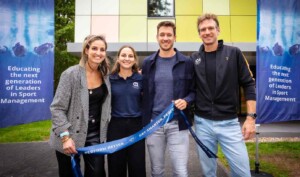
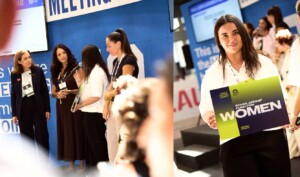
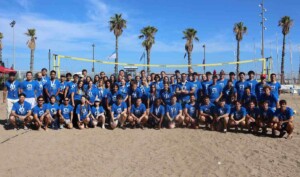
Johan Cruyff Institute organizes extracurricular academic days on specific aspects of sport management: the football industry beyond the playing field and a day in Barcelona’s Port Vell to learn about the activities of entities linked to the blue economy are two of the proposed days
Johan Cruyff Institute continually seeks new ways to enrich the student experience and direct contact with professionals from the world of sport management is one of them. This passion for training the future leaders of this industry translates into organizing extracurricular academic days throughout the year, new opportunities for students to learn more about the activities of entities in different sectors and to build professional relationships with other managers and directors in the sector.
The aim of these days is to put students at the center and to give them first-hand knowledge of the challenges, difficulties and best practices faced by sport professionals in their daily work: round tables that encourage debate on cutting-edge issues in the industry and guided visits to unique sports facilities or venues that include a classroom session led by the managers themselves. The sporting proposals offered by Barcelona’s Port Vell or the diversity of management models in football in different countries are some examples.
Sport management on the seafront
Students are used to hearing about cases from the world of football or other popular indoor sports with similar characteristics. However, the management of a maritime institution is, in most cases, beyond their knowledge and, therefore, it is of great importance that they have an opportunity of this kind. This was the theme of the sport management day at Barcelona’s Port Vell.
All this, coinciding with the appointment of the Catalan capital as the venue for the 37th edition of the America’s Cup, the most prestigious sailing competition in the world, which will be held in 2024. This event will not only have an economic impact of €1 billion on the city and its surroundings, but, through the Barcelona Ocean Sailing Foundation (FNOB), it will also guarantee a legacy that will last over time and generate a sports industry linked to the sea.
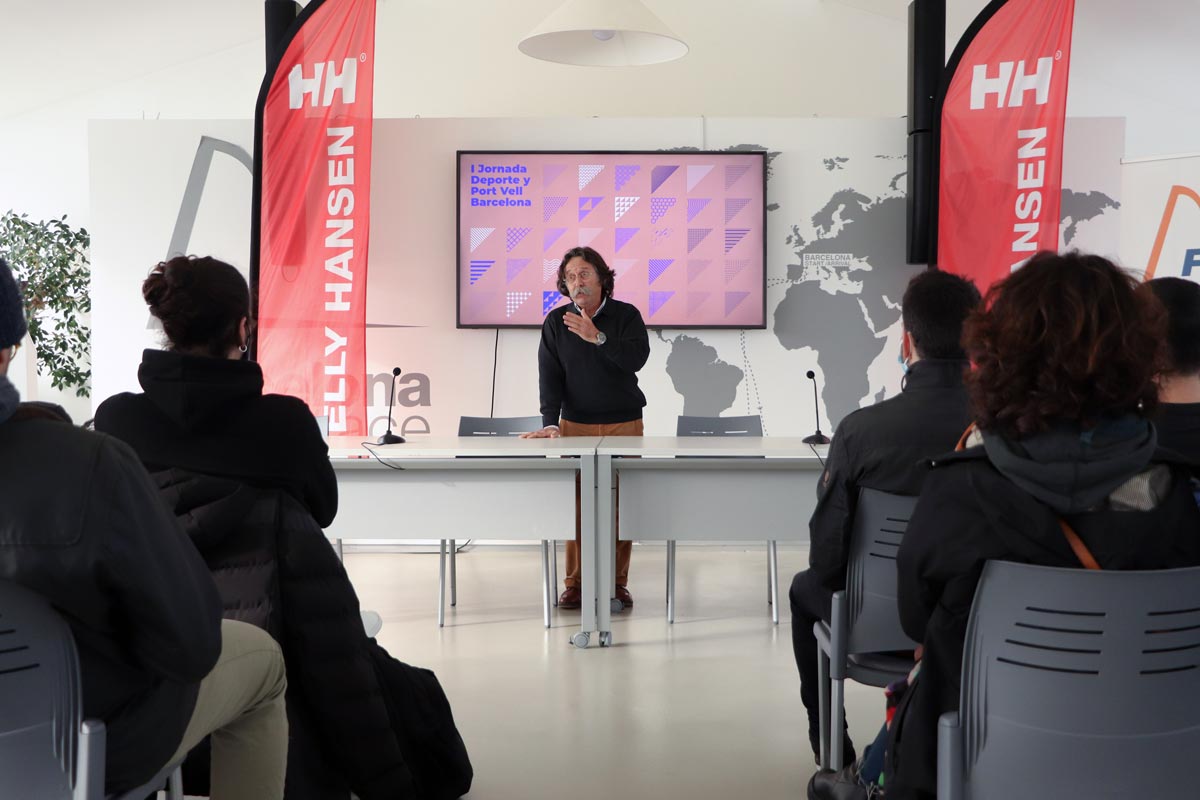
Carlos Sastre, FNOB’s communications director, explained what the Foundation consists of and the activities it carries out.
The event was attended by students from the Official Master’s Degree in Sport Management and the Blended Master’s Degree in Marketing and Sport Management, and began with a boat ride around the port, accompanied by Elisabeth Barcons, marketing and commercial director of the Port Vell de Barcelona.
“In my specific case, coming from the world of swimming, the fact of being able to compare the different projects that the two clubs have, and how they face the present and the future while struggling to grow together, shows the differential point in an incredibly competitive world,” explains Oscar Traver, student of the Official Master’s Degree in Sport Management.
At the facilities of the FNOB, the students were able to see first-hand the White Shadow, the boat owned by Marc Miró, skipper and project manager of the Ocean Global Race 2023. Miró explained to them what the preparation for the race consists of, how they obtain sufficient funding to participate and compete and other aspects of interest. The students were able to learn about the FNOB, co-organizer of the America’s Cup 2024.
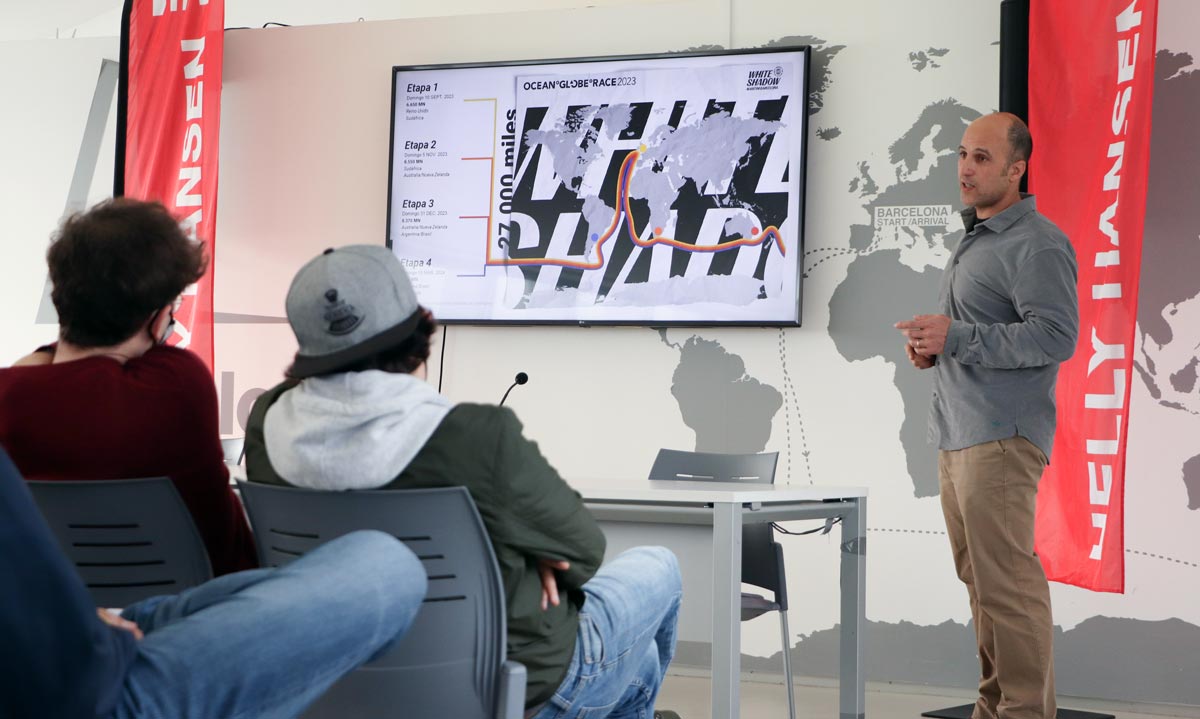
The students learned about the Ocean Global Race 2023 project from the captain of the White Shadow, Marc Miró.
The day also featured several presentations by experts in the management of water sports. Carlos Sastre, director of communication at the FNOB, explained what the foundation is all about, who its members are and the activities they carry out, and Mireia Cornulleda, head of the educational part of the FNOB, highlighted the foundation’s work in disseminating information. “It is important to have a broader vision to see how things are being done in each area, to absorb and learn about everything that is being done better than in our own,” added Adrià Vilar, one of Traver’s classmates on the master’s degree.
The day ended with a round table with the participation of: Xosé Carlos Fernández, general director of the CN Barcelona; Héctor Cruz, project manager at the CN Atlètic Barceloneta; Sonia Güell, commissioner of the Barcelona International Rowing Center (BIRC) project; and Elisabeth Barcons herself. In this space, the role of the activities carried out by each of the institutions represented was analyzed and the role these entities have in the sporting and social offer as public or private entities was discussed.
“The lesson I learned is that clubs with so many years of history and so many people are very difficult to manage, regardless of the sport. You need a lot of communication and a great team to—never more appropriately said—all row in the same direction,” says Carlos Cruz, student of the Blended Master’s Degree in Marketing and Sport Management.
“It has been a great opportunity to get to know an area that is not usually on the front page, and not only that, but which ends up encompassing many more entities and acquires greater importance than we might have thought at first,” adds Oscar Traver. For his part, Vilar says that “there is no single approach when it comes to managing a sports entity—even though they are non-profit organizations, they have to ensure that they have more income than expenses.”
“There is no single approach when it comes to managing a sports entity—even though they are non-profit organizations, they have to ensure that they have more income than expenses” – Oscar Traver, student of the Official Master’s Degree in Sport Management
One of the objectives of the event was to present the concept of the blue economy: the sector that refers to all those activities and sub-sectors of ports that encompass all types of maritime transport, fishing, product marketing, nautical repairs or the so-called ‘blue tourism’.
In the case of Barcelona, moreover, it is a providential time for the port with the development of water sports in the coming years. Last April, the City Council of the Catalan capital announced an investment of €26.7 million for the creation of an open-air sports area aimed at nautical, aquatic and beach sports. Sport will play a key role in boosting the blue economy.
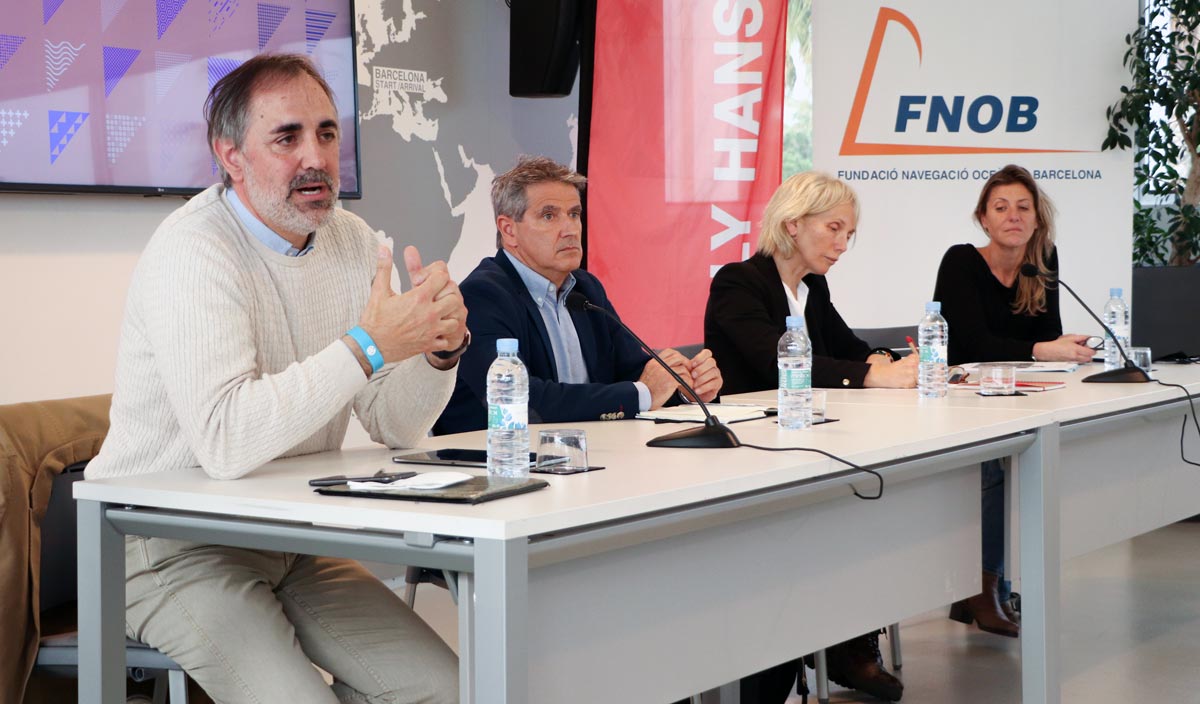
Xosé Carlos Fernández, Héctor Cruz, Sonia Güell and Elisabeth Barcons, speakers of the round table.
This is why Johan Cruyff Institute chose to organize this academic conference at the FNOB facilities, at a time when Barcelona is working on the Blue Pavilion project. This involves the construction and remodeling of a set of sport complexes to convert the city’s waterfront into the city’s largest outdoor sports area. The project, which will be completed in 2030, will cover a length of five kilometers from the Port Vell to the Port del Fòrum and will include spaces for 40 different sports disciplines.
Behind the football pitch: the managers have their say
Virtual conferences that bring together managers from different parts of the world in the same space are also commonplace. Representatives from Bayern Munich, Sevilla FC, River Plate and Real Zaragoza, as well as from the ISL agency and FC Diez Media talked about the consequences of the Covid-19 pandemic on the internationalization of entities, the evolution of the football industry, the keys to attracting talent and the most required skills to work in the sector.
Representatives from Bayern Munich, Sevilla FC, River Plate, Real Zaragoza, ISL Scouting and FC Diez Media talked about the consequences of the Covid-19 pandemic on the internationalization of entities, the evolution of the football industry, the keys to attracting talent and the most required skills to work in the sector
María Barberá, head of marketing and sales at FC Diez Media, in charge of marketing sponsorships and rights for Conmebol, valued the growing importance of entertainment in the football industry and the need to adapt to digital platforms such as Twitch and TikTok. “Digital is not the future, it is the present,” said Barberá, who also explained that during the pandemic “there was no football on the pitch, but there was at home”, so they decided to create workshops and launch content promotion campaigns with sponsors such as EA Sports.
Meanwhile, Carlos Arranz, commercial and marketing director of Real Zaragoza, pointed to the time of the pandemic as the moment of greatest creativity, intensity and demand in the sector and pointed out the relevance of digitalization despite the fact that, as he warns, “there are still many professionals who have not digitalized”.
“Digital is not the future, it is the present; during the pandemic, there was no football on the pitch, but there was at home, so they decided to create workshops and launch content promotion campaigns with sponsors” – María Barberá, marketing and sales at FC Diez Media
The head of sustainability at Sevilla FC, José Viñas, stressed the need not to forget the older generations who are not familiar with the digital world so as not to leave them behind and assured that “digitalization will go hand in hand with sustainability”.
Similarly, Juan Cascio, director of sponsorship at River Plate, explained the work they had to do to be able to offer new content to brands during the pandemic without the possibility of having the players themselves. Cascio noted that digital migration has become a reality, “not just driven by the pandemic”.

Andrés Vargas, who is part of FC Bayern’s business development team in Latin America, pointed to importance of searching for opportunities in times of crisis, as they did at the Bavarian club with the cancellation of the pre-season tours. “They went digital and that allowed us to engage more people and generate activations all over the world, not just where we were going to play the friendlies,” he said.
“Digitalization will go hand in hand with sustainability” – José Viñas, head of sustainability at Sevilla FC
Àlex Isern, co-founder and CEO of ISL Scouting, explained their commitment to eSports and the NFT business and said that the pandemic allowed them to reflect on agreements or projects they had in place that were not of interest to them. In this sense, he warned that “sometimes it seemed imperative to grow internationally in the United States and China, but this did not make sense.”
At the end, following a round table debate, the students were able to participate in small group discussions with the speakers, which gave them an opportunity to introduce themselves and to network with the different managers. Thus, in addition to the knowledge gained during these events, the students of Johan Cruyff Institute can establish interesting contacts with the sports industry.