A blended learning program is a dynamic and flexible approach to education that combines online learning with traditional classroom-based instruction
At the Johan Cruyff Institute’s Master in Sport Business, we offer a blended learning program that allows you to access course materials online and attend on-campus classes during intensive weeks. This innovative learning model is designed for professionals who want to pursue their master’s degree without sacrificing their work and personal commitments.
Here are some reasons why you should consider enrolling in the Master in Sport Business blended learning program:
- Blended learning mode
- Profile of blended learning students
- Competencies
- What is the difference between the blended master’s degree and the university master’s degree?
- Study trip to Amsterdam
- Visits to sports facilities
- Round tables and professional conferences
- Career Services, ‘Step Day’, and the Johan Cruyff Institute Alumni Platform
Blended learning mode
The blended learning mode applies to all modules and all teachers. In face-to-face sessions, we try to avoid theoretical presentations; it’s about applying ideas, concepts, even a student’s own experiences from other professional environments or from his or her sporting experience, whether in a professional, semi-professional or amateur setting. We apply ‘learning by doing’.
In some modules, projects are developed: different ideas and concepts are worked on and acquired through a real project, which can be based on a company, an organization, a club, federation, etc. Managers of the entity in question present the company and the problem they have to the students, who then work in teams on possible solutions to that problem and, at the end of the project, they present them to the company. This collaboration is highly valued both by the companies or organizations involved and by the students because they work on cases that are not only practical but also real, based on a problem initially identified.
Teamwork, the mixing of cultures, and sharing of previous experiences are also very much encouraged, and we try to guarantee this active participation in the different projects, activities and modules.
As in any sport, we organize a short pre-season whose objective is academic, to better understand how the technology works. In spite of being a program requiring considerable physical presence, as it is a blended learning program, it is a hybrid course and the student has to know and understand how a series of tools work in the virtual campus. We also take this opportunity to initiate networking among students, so that they can get to know each other and some of the staff and start working together. All of you who like sport or are athletes know that the pre-season is not only to get physically fit—in this case to understand well how the master’s degree works—but also to meet your fellow travelers.
All the modules are very structured. There is a first introductory part that is theoretical, which provides students with the theory and knowledge they need to progress in their own time and at their own pace. We aim to ensure that, through the combination of webinars, face-to-face classes, case studies, materials, readings and articles, you understand the theoretical foundations.
From there, the second and third parts are entirely practical. There are modules that only have two parts and there are modules that have three parts.
The modules with less weight in terms of credits or time have a practical part in which the students do in-class simulations, company case studies and workshops.
Then there are modules, such as those on strategic and facility management or sponsorship, in which, in the third part (with a duration of 3 weeks or a month), representatives from FC Barcelona or Joventut, a federation, or some other sport-related company can come and present a real situation in which they are unsure about what to do, either because they just do not know which direction to take or, simply, because they do not have the time or a team available to develop a proposal or plan. That is where students cooperate and try to come up with a solution. In the end, it is a very significant learning experience because it is not just a fictitious challenge, but a business reality. It is very motivating because that club or institution is challenging us. It is a win-win for everyone. It is an opportunity for students to show their worth in front of a future contact that is going to have a very positive perception of them.
Representatives from FC Barcelona or Joventut, a federation, or some other sport-related company can come and present a real situation in which they are unsure about what to do. That is where students cooperate and try to come up with a solution.
Our methodology is based on applicability and real cases. We guarantee networking—a fundamental aspect of any master’s degree—between students and companies.
We are a small institution, highly specialized in the world of sports, and we differ from the big universities in our decision-making speed. This flexibility is essential in an industry like the sports industry, where areas that did not even exist 10 years ago, such as eSports, are today a sector of great opportunity. Other examples could be those derived from technology applied to physical activity and health.
It is undeniable that a company wishing to link up with the sports industry needs professionals who understand its management and that opens a very wide range of opportunities. One of our objectives is that students know all the options they have at the end of their master’s degree to help them choose what really satisfies them.
The objective of these programs is to accompany you in your development as well-rounded professionals in sport management and marketing, and to train you in the use of management tools to recognize business opportunities, establish strategies, anticipate changes, optimize resources and analyze information with criteria.
Advantages of blended learning
These programs are designed for people who are already professionally active, who wish to maintain a face-to-face study mode, yet make it compatible with their work schedules. And also, for those students coming from Latin America, it has the advantage of being in a city with a very highly developed sports industry; as a result, their experience would not only be to study the master’s degree and attend the face-to-face classes but also to enjoy the infinite number of sports events that constantly take place in Barcelona. There is a sports industry cluster in Barcelona, so there is a lot of sport-related activity happening in the city and, obviously, coming from a Latin American country you can use this as a complement to the master’s degree.
How do you combine face-to-face sessions with online activities?
The modules’ method of study usually alternates between weeks (some weeks there are face-to-face sessions and other weeks it is all online work). The teacher establishes a series of activities to be done before and after the face-to-face session. The idea is that you organize your time and learn to manage your studies because that’s what a master’s degree in management is all about.
There are individual and group sessions, face-to-face sessions, online webinar sessions, and part of the work involves reading, management, thinking, research, which you will have to do on certain days. A master’s degree is an immersive experience and it will, directly or indirectly, take up your week.
Profile of blended learning students
We have three student profiles:
- People who are finishing or have already finished their sports careers and who are thinking about what they are going to do next, because many already have a background in the industry, but now they want to enter the world of management and they need training to complement their abilities.
- People who have been working in the world of management for years—probably not strictly linked to sport—and need to update their knowledge or want to change their industry.
- We also have some students who perhaps are younger, have had some professional experience, but realize that their passion is sport and want to make that transition and get training in the field they like and to which they would like to dedicate their professional career.
Having such a varied profile of students is very enriching because, as a student, it allows you to meet not only (former) high performance athletes, but also people who already have a really long professional career with positions of responsibility, as well as people who already have a level of training. This combination allows for interesting interaction in the classroom and a high level of involvement.
Blended learning versus on-campus and online learning
The on-campus master’s degree is for people who may feel, on the one hand, more secure having an official qualification, who are also younger, have more free time or are looking for an immersive experience of living for a year outside their usual place of residence, and who may also be thinking of doing a doctorate, and therefore dedicating themselves to a career in research or teaching, despite the fact that it is a professional master’s degree, or they may want to sit the official exam required to join a public entity.
The blended learning master’s degree is for those who are able to combine work, cultural experience and study, and who are able to self-manage well, their time, their learning, etc. It is for those profiles who wish to continue training in sport management without a special interest in research or in taking the official exam to join a public entity.
The online master’s degree is for students who do not have the time to travel, who are not looking for a 10-month experience with many hours of face-to-face contact, but who are looking for training that will allow them to upgrade professionally, to learn in an environment that is closely linked to the field of sport and that will also provide them with options for professional improvement.
Competencies
The competencies obtained go beyond the knowledge and information that you are going to acquire along the course of the different programs, and ultimately are the tools and abilities that you are going to be able to transfer to all those opportunities that we provide you.
We are a very competence-based institution. Our programs are not based on theoretical information but, above all, they try to provide the students with knowledge and tools they can apply in practice in the specific area covered by each of the modules. Each module has some learning objectives and the aim is that by the end you will know how to do a certain number of actions.
We are a very competence-based institution. Our programs are not based on theoretical information but, above all, they try to provide the students with knowledge and tools they can apply in practice in the specific area covered by each of the modules.
Our teachers are aware of the effort you are making, since many of those who end up signing up for this master’s degree are people who are working or active on a professional or sports level, and therefore, this is an additional activity and the time dedicated by the students must be respected. In this sense, we are also very clear that, to get a theoretical explanation of a subject, nowadays you can just as easily to buy a sport management book or google a few key words. We totally avoid this: with a conceptual base and management tools that must be useful in the future, we start with practical cases, with examples of current real-life cases in the sports industry.
Fortunately, it is a very rich industry in which things happen every day and we use these elements as a lever to really be able to apply these ideas, these management instrument concepts that exist. The varied profile of students that there are normally in the classes also helps a lot to share—mainly in the face-to-face sessions—and to discuss and validate ideas, concepts and proposals that have been worked on previously in the more online part.
What is the difference between the blended master’s degree and the university master’s degree?
- Basically, there is a first difference which is “legal”. The University Master’s degree in Sport Management we teach with the Autonomous University of Barcelona (UAB) is an accredited master’s degree. The difference is that an accredited master’s degree gives you the option, once you have finished, to continue with your doctoral studies and/or be able to take the official exam required to be able to join a public entity. In other words, if you want to get a ‘doctorate’ degree, you have to follow an accredited master’s degree, and there are very few such degrees in Spain.
- The second difference is that an accredited master’s degree has a series of regulations established by a European government foreign accreditation agency (the two agencies in Spain are Aqu and Aneca). In the accredited or university master’s degree, there is a module on ‘economics applied to sport’, which is not included in the blended master’s degree.
Study trip to Amsterdam
The study trip is included in the price of the master’s degree. The study trip gives you the opportunity to network. Students from the different programs in Barcelona (University Master’s degree in Sport Management, Master in Sport Business blended Barcelona, Master in Sport Marketing and Management blended Barcelona and the Master in Football Business in partnership with FC Barcelona) and from the online master’s programs join up with students from the Master in Sport Management in the Netherlands. These trips combine teaching activities with visits to sports facilities, clubs and companies.
It includes a workshop at a company that poses a challenge and, working together with colleagues from other programs, the students try to respond in a limited time. It ends up being an interesting and very enriching experience. In addition, Amsterdam is a very beautiful city. In spring, it is fantastic and there are lots of things to do. All in all, they are three intense days when the students hardly sleep and everyone has a great time.
The study trip includes accommodation and activities, but not the flight. It usually coincides with the days before or after the Easter holidays, so it is a good opportunity to extend your stay and do some sightseeing.
Visits to sports facilities
The module on ‘Facilities’ includes three or four visits to sports facilities, which are complemented with a presentation by a director of the organization or a member of the staff. For example, we visit the Circuit de Barcelona-Catalunya, which hosts the F1 and MotoGP World Cup races, and the director himself, Joan Fontserè, explains all the idiosyncrasies of managing his facility: from the financial point of view, the great economic impact that a Formula 1 or MotoGP race generates, as well as the costs involved in being able to have a race of this type, and the deficit that it generates, and that finally the government ends up subsidizing.
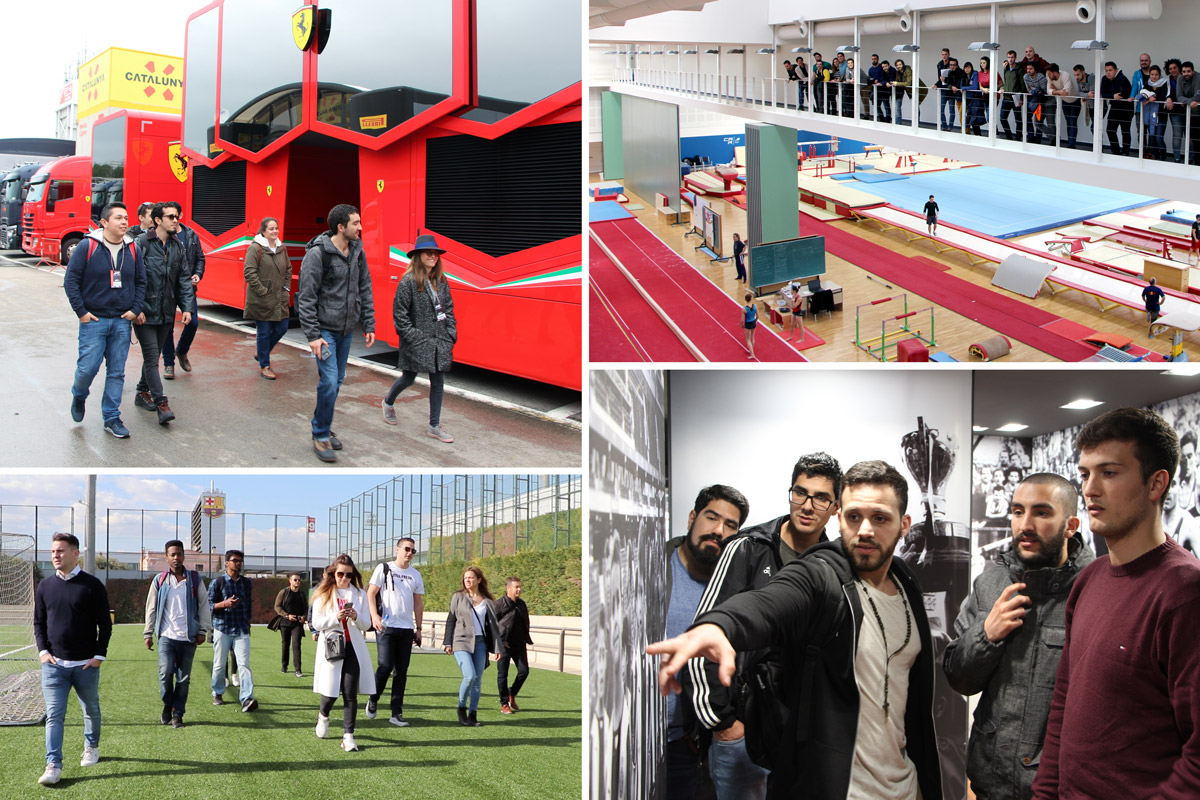
We also visit FC Barcelona’s youth academy, La Masia, and the stadium of RCD Espanyol which is a really exemplary stadium, very well designed and considered one of the best in Europe.
The module on ‘Facilities’ includes three or four visits to sports facilities, which are complemented with a presentation by a director of the organization or a member of the staff.
We also go to the CAR, Sant Cugat, the high performance center par excellence in Catalonia, where the technology director of the center explains all the technological innovations that are incorporated every year to favor the development of their athletes.
In addition to a tour of the facilities, the visits offer these talks as an added value, always with a different theme to complement the content of the module.
Round tables and professional conferences
The fact that our teachers are experienced professionals from the sports industry is a plus because, through their professional contacts, we are able to organize round tables on specific topics. The guest speakers at these, who are not teachers, but rather managers in their field, are invited to explain their own experience and this greatly enriches student’s vision.
The fact that our teachers are experienced professionals from the sports industry is a plus because, through their professional contacts, we are able to organize round tables on specific topics.
Career Services, ‘Step Day’, and the Johan Cruyff Institute Alumni Platform
We work with institutions and companies that share our vision and values. We have signed agreements with more than 170 entities linked to the sports industry and we collaborate with more than 300 companies and institutions in organizing internships, talent exchange, training offerings, consulting projects, case study analyses, the development of webinar content, etc.
From the Career Services department, job offers or internships are announced, not only from related institutions, but from all those companies that are looking to incorporate talent into the sports sector.
Work placements in the blended learning program are not compulsory, but that does not mean that they are not interesting for students. To this end, every year we organize the ‘Step Day‘ at the end of October—normally at the old Estrella Damm beer factory—to put companies and clubs in the sector in touch with students who are looking for work experience.
On the Step Day you will be able to make contact with about 20 companies. We also offer you the chance to attend iWorkinSport, a recruitment fair held in May in Lausanne, where we offer students and alumni the opportunity to arrange job interviews with international companies and sports organizations. As we are an academic partner of SportBiz Europe, you will also have the option of attending one of the biggest congresses in the sports industry.
If you’re looking for a blended learning program that prepares you for a career in the sports industry, the Johan Cruyff Institute’s Master in Sport Business blended in Barcelona is an excellent choice. With a focus on practical skills and real-world experience, this program will help you achieve your professional goals and become a leader in the sports business.