Professional football is not decided only on the pitch. Every season is shaped by a chain of decisions that begin long before the first whistle, connecting sporting performance, finances, commercial strategy and institutional leadership. Understanding those connections is the first step toward managing the industry with sound judgment.
That way of reading football as a system where everything is interconnected is not a business school trend. It is the same mindset that allows someone to see a pass before it happens, interpret an off-the-ball movement or anticipate an opponent’s weakness. Anyone managing football today needs to apply that same game intelligence to a broader reality: a club that is simultaneously a team, a brand, a community and an economic project.
This is not about adding business management to sport as if they were two separate worlds. It is about understanding that every sporting decision has financial consequences, that every sponsorship can strengthen or dilute an identity, and that relationships with fans require balancing commercial value with long-term trust.
At Johan Cruyff Institute, football business starts from a simple idea: football is better understood when you learn to read it as a whole. On the pitch, that understanding helps improve decision-making. Off the pitch, it allows professionals to manage organizations, projects and opportunities without losing sight of the essence of the game.
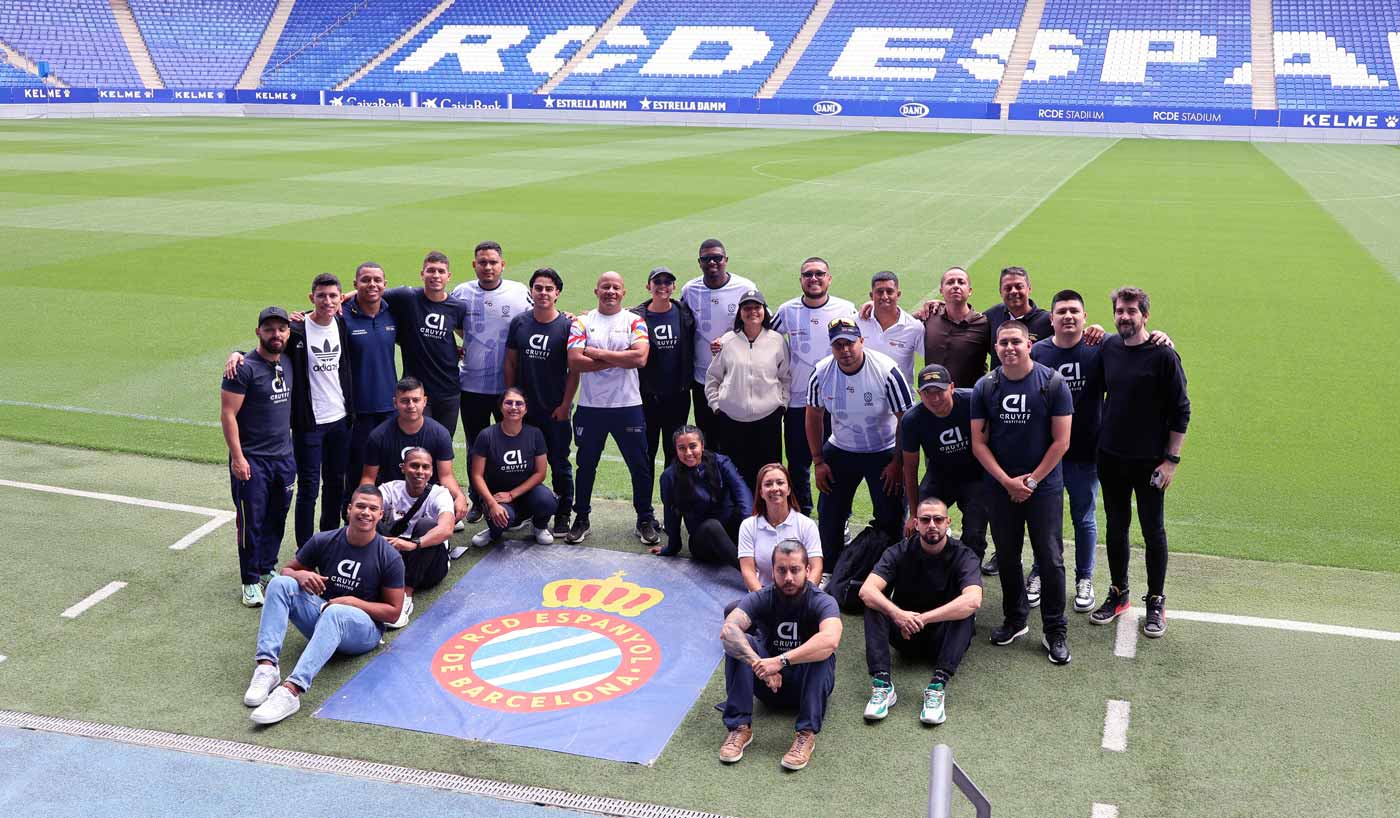
Johan Cruyff Institute students visiting the RCDE Stadium.
Why study Football Business now
According to Deloitte’s Annual Review of Football Finance 2025, the football industry in Europe reached €38 billion in the 2023/24 season. That figure reflects the economic scale of the sector, but finance is only the surface. What truly matters is the complexity behind the decisions that sustain that value.
A transfer, for example, is not just a sporting operation. Behind it are scouting, negotiation, financial analysis, dressing-room dynamics, fan expectations and institutional planning. FIFA reported that 2025 saw a record 86,158 international transfers, with spending reaching $13.11 billion. Those numbers show why talent has become a strategic dimension that requires structure, methodology and clear decision-making.
For years, intuition and dressing-room experience were enough to guide many decisions. That intuition still matters when it is grounded in real experience and a deep understanding of the game. But repeating old formulas without understanding the context is no longer enough. Studying football business means learning to navigate the tensions that define the industry, from sporting pressure and financial sustainability to social expectations, without reducing them to a single logic.
Education helps channel passion and experience into professional judgment. It transforms an interest in football into the ability to understand which decisions should be made, why they matter and what consequences they may have across the organization.
Career paths and professional opportunities
One of the most common misconceptions is that working in football requires having played professionally. Justin Anderson-Louch is a strong example of how the industry is also built through analysis, management and professional development roles. Justin studied the Master in Football Business in partnership with FC Barcelona thanks to a scholarship from Johan Cruyff Institute and Premier Soccer Leagues Canada, and his journey shows that football knowledge can also be applied from positions far from the spotlight of matchday.
“It’s important to understand that you don’t need to be directly on the pitch to work in the football industry. There are many opportunities off the field, on the business side, that still allow you to stay involved.”
His point is clear: you do not need to be on the pitch to work in football. The industry needs professionals who understand the football context and can contribute through strategic leadership, academy management, sponsorship, communication, business development or data analysis.
What matters is not visibility, but understanding how your role contributes to the broader project.
Juan España, president of Escorpiones de Belén, a second-division club in Costa Rica and graduate of the Master in Football Business in partnership with FC Barcelona, highlights the value of learning directly from active professionals in the industry.
“What stood out most was that the professors were active professionals in the industry. That made all the difference. They shared their day-to-day experience and how football really works behind the scenes.”
Peter Lund, graduate of Johan Cruyff Institute’s Master in Football Business Online and Head of U10-U13 and Club Partnerships at Vejle Boldklub, offers another perspective. In an interview published in The Magazine, he explained that the master’s program gave him a deeper understanding of the business mechanics of football, and that the knowledge he gained, combined with his role at the club, helped strengthen his position within the sporting department.

Peter Lund, alumnus of the Master in Football Business Online, works as Head of U10-U13 and Club Partnerships at Vejle Boldklub.
“The Master’s gave me a deeper understanding of how the football business works, which helped me grow professionally. The work I developed around the club was also recognized internally, something I truly value.”
Peter’s experience shows that the football business is not limited to major international deals. It is also present in the way academies are organized, how clubs build partnerships, how they engage with families and supporters, and how they create a coherent long-term strategy.
Jorge Giordano, director of national teams at the Asociación Uruguaya de Fútbol, brings another perspective focused on sporting structures. In an interview with Johan Cruyff Institute, he explained that his role relies on three essential pillars: methodology, infrastructure and human resource development.
His reflection reinforces a key idea: talent wins matches, but structure sustains projects:
“If you don’t have the tools to manage and plan, experience alone is not enough. It would not be appropriate for someone without training to manage a sports organization.”
All these examples point in the same direction. Football management is not about observing the game from a distance. It is about understanding it more deeply in order to make better decisions from different areas of the industry.

Juan España, alumnus of the Master in Football Business in partnership with FC Barcelona, is president of Escorpiones de Belén, a club in Costa Rica’s second division.
How to choose the right program
The first question is not which program to choose, but what kind of professional you want to become. Those looking for a broad understanding of the industry need a program that connects strategy, finance, marketing, talent management, governance and football culture. Those already working in the sector may need to organize their experience and update their knowledge. Those coming from other industries need a pathway that translates their skills into the language of football.
At Johan Cruyff Institute, football management programs respond to those different stages. The Master in Football Business Online and the Postgraduate Diploma in Football Business Online offer a strategic overview for professionals seeking to understand the industry from a global perspective. The Master in Football Business in partnership with FC Barcelona connects academic learning with one of the leading environments in international football. The Master in Sports Management and Football Business Lima, and the Course in the Essentials of Football Business Online complete a portfolio designed for different professional profiles, career stages and contexts.
For more specific objectives, specialized courses allow professionals to deepen their knowledge in areas such as strategic planning, digital transformation, branding, commercial management, stadium operations, communication or preparation for the FIFA football agent exam. The key is not accumulating qualifications, but choosing a program aligned with your starting point and the kind of value you want to bring to the industry.
That decision is also part of learning how to read the game. It is not only about chasing opportunities, but about understanding the space you want to occupy, the skills it requires and how to prepare yourself to make a meaningful contribution when the moment arrives.
Managing football means understanding the game
Studying football business does not diminish passion for the game; it gives that passion direction and perspective. It means moving from simply feeling the match to understanding the system that makes it possible, and from there, making decisions that respect both sporting identity and long-term sustainability.
A club is not just a company. A player is not just an asset. A stadium is not just a venue. A sponsorship is not just a source of revenue. A fan is not just a consumer. In football, every decision touches emotional, cultural and collective relationships that must be managed with intelligence and care.
That is why the real professional advantage does not belong to those who believe they already have all the answers, but to those who learn to read the industry as a connected whole. Managing football means understanding the game, understanding the context and making decisions that matter beyond the immediate result.
Discover the football management programs at Johan Cruyff Institute and choose the education that best matches your way of understanding the game.
FAQs
What is football business?
Football business is the professional administration of organizations and projects connected to the football industry. It helps professionals understand how decisions are made that link sporting performance with financial sustainability, club identity and relationships with fans.
Why is it important to study the football business?
Because professional football combines competition, business, community, identity and economic pressure. Studying the industry helps professionals understand that complexity and make more informed and structured decisions within clubs, academies, federations and football-related projects.
Who can study football business?
Football business programs are open to athletes in transition, coaches, graduates, sports professionals and people from other industries who want to enter the football sector. The key is choosing a program that matches previous experience, professional goals and availability.
Can you work in football without having been a player?
Yes. The football industry needs professionals in management, communication, marketing, analysis, operations, sponsorship, business development and institutional projects. Having played football can provide valuable experience, but it is not the only path to building a career in the industry.
What careers are available after studying the football business?
A football management education can lead to careers in executive leadership, academy management, sponsorship, communication, fan engagement, operations, talent management, player representation, business development, or projects within federations and sports organizations.
How do you choose the right football business program?
The best starting point is your professional goal. Someone aiming to lead a club does not need the same education as someone interested in communication, stadium operations, talent markets, preparing for the FIFA football agent exam or entering the industry for the first time.