In an interview on the Impulsyn podcast, Cristina Pales, Marketing and Communications Director at Johan Cruyff Institute, discusses the institution’s history, strategy, and educational approach.
Since its founding in 1999, Johan Cruyff Institute has evolved from an educational institution dedicated exclusively to athletes into an organization offering more than 90 programs and combining online learning with campuses in five different countries. Cristina Pales, Marketing and Communications Director at Johan Cruyff Institute, witnessed that transformation firsthand.
In this interview, Cristina explains the vision of the legendary footballer, the key factors behind the institution’s growth, and how Johan Cruyff Institute’s commercial strategy has evolved over the years.
Cristina, your history with Johan Cruyff Institute goes back many years. When did you start working here?
I started here in 2008 or 2009. There were very few of us: Johan’s big ideas and four or five people.
We quickly incorporated online learning. Perhaps we were pioneers in understanding that, without flexibility, athletes could not combine their studies with their sporting careers. We started in 1999 in the Netherlands with 35 elite athletes alongside the Amsterdam University of Applied Sciences. Later, because Johan was living here in Barcelona, he said we needed to do something here as well, and that was how we began promoting the dual-career concept.
What was Johan’s vision?
His main vision was to help athletes prepare for life after sport, especially in football, although he always thought about athletes from all disciplines. We started here with footballers, but also worked with basketball players, track and field athletes, and tennis players. We expanded and realized that realities varied from country to country, that there was a huge need for qualified professionals, and that no specialized education existed for them. That was the niche.
“Johan never had the opportunity to study, but he always understood how important education was”.
He had seen many teammates struggle after retirement. I remember one in particular, Cholo Sotil, who played with him and ended up in a very difficult situation, and Johan always helped him. For Johan, it was essential not to forget about what comes next, because it arrives much sooner than any athlete imagines.
He had a great quote: “Who better to lead sport than someone with the heart of an athlete?” His idea was to educate athletes in management so they could become leaders in the industry.
He believed elite athletes possess valuable qualities that companies can benefit from, but often do not realize how much they already know. They simply need someone to help them transfer those skills into the business world.

Johan Cruyff in 2013, with students of Johan Cruyff Institute in Amsterdam.
Have you noticed a lot of change since you started working here?
It is completely different. We worked with Excel spreadsheets; everything was manual. We have gone through a full digital transformation. Back then, payments were made by bank transfer and tracked in a spreadsheet.
Today, we have a CRM integrated with our website, an e-commerce platform, and automated processes. It is another world, and the pace of change has been remarkable.
Has the organization expanded globally?
Yes. We have elite athletes in the Netherlands, professionals here in Barcelona, and campuses in Mexico, Peru, Colombia, and Uruguay. In fact, we opened one in Tbilisi, Georgia, today.
In the Netherlands, we have a large network of agreements with major universities and work exclusively with Dutch elite athletes. That is a unique characteristic of that network.
“Within The World of Johan Cruyff, the family of brands he created, we represent the academic legacy, known as Cruyff Education. Within that structure, there is Johan Cruyff Institute, which is us, and then Johan Cruyff Academy and Johan Cruyff College, which only exist in the Netherlands and focus on Dutch elite athletes”.
Johan Cruyff Institute operates worldwide, and thanks to our virtual campus, we reach all five continents.
Our faculty pool is divided into two groups. On one side, we have official programs delivered in partnership with the Universitat Autònoma de Barcelona, which require academics with doctoral qualifications.
On the other, we have industry experts: professionals who bring real-world practice into the classroom. In addition, some sports organizations lack the resources to develop certain projects and bring them into the classroom. Students work on them and return them to the organizations, and many of those projects eventually become reality.
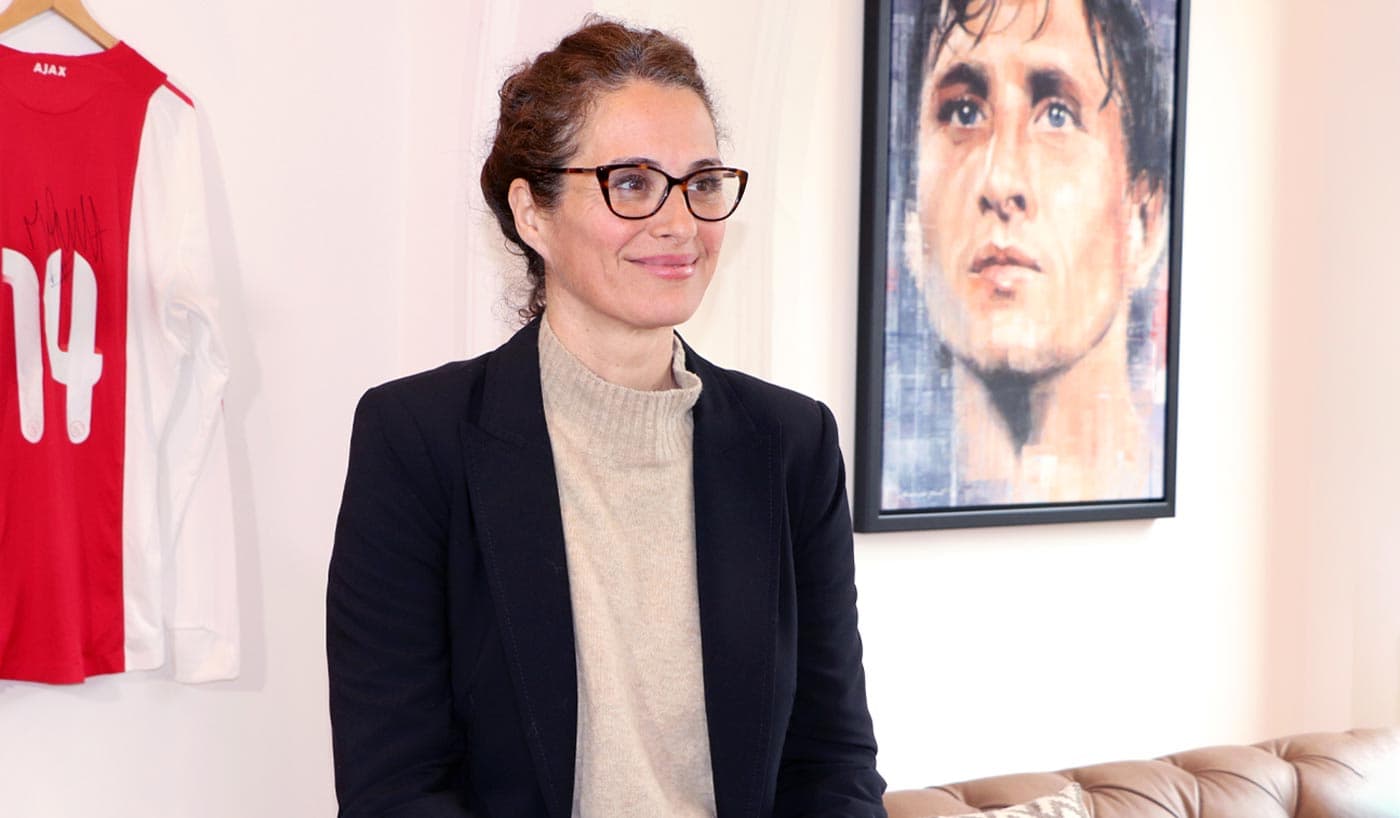
Cristina Pales is Marketing and Communications Director at Johan Cruyff Institute.
Have student numbers grown as well?
Yes, significantly. Before the pandemic, we were the only institution in this sector with an online learning platform.
The pandemic forced everyone to digitize, but I believe that if you stay true to your DNA and maintain a long-term strategy, you survive. We are a small company, with 26 or 27 employees, but we have a very powerful brand.
What does sport management mean to you?
Sport is a cross-sector industry. Management encompasses finance, law, people management, marketing, and strategy. Career opportunities are everywhere: sporting events, facilities, fan engagement, innovation, data analytics, and artificial intelligence applied to sport.
I also see a growing balance between technology and the human side of sport, as well as a stronger focus on mental health, sustainability, and gender equality.
What role does supporting female talent play for your organization?
As a woman, I always noticed that classrooms were mostly filled with men, and I wondered why. If we want more women in the industry, we need female leaders who serve as examples and open doors. There are still too few of them, but this year, for the first time, one of our master’s programs has more women than men: the Master in Sports Business and Marketing Blended Barcelona. I think this has a lot to do with the rise of female athletes, FC Barcelona Women, for example, and the role models they create.
There is still progress to be made in sports governing bodies, where men continue to dominate, but I hope that changes. It is not about having only women; it is about achieving a balance, because that is what enriches organizations. In my own team, the numbers are more or less equal, and that was not intentional; it simply happened naturally.
“Barriers are broken through examples. Someone has to have the vision and courage to make the commitment and demonstrate that it is possible. Over time, it becomes normalized”.
You also offer specific scholarships. What do those scholarship programs involve?
We have two funds. One is aimed at women who want to enter the sports industry, whether or not they are elite athletes. The other, called The Cruyff Athlete Fund, is for minority sports and for countries where access to education is more difficult, such as Ethiopia, Palestine, and several African countries where the sports being practiced attract little sponsorship and athletes receive limited financial support. Some scholarships cover the full cost of studies, while others are partial.
What is the difference, for you, between building a brand and promoting a program?
From the beginning, we understood that we sit at the intersection of sport and education. On one side, we work with the sports ecosystem: when we target a country, we engage with all stakeholders, from governing bodies to small clubs, assess training needs, and identify opportunities for improvement. On the other side, we establish academic partnerships, such as the one we have with the Universitat Autònoma de Barcelona.
As for the student profile, we attract graduates who want to work in sport, but also professionals from tourism, communications, marketing, economics, law, and even architecture.
“In the classroom, five very different profiles come together: active athletes, recently retired athletes, recent graduates, sports professionals without formal qualifications, and professionals from other industries looking to transition into sport”.
Each contributes something the others may be missing.
What is the main channel through which people discover you?
A combination of organic positioning on Google and recommendations from alumni. In education, Google remains highly relevant. Even when someone asks ChatGPT a question, they often end up being directed to a website. We also work continuously to engage with the global sports ecosystem, establish partnerships, offer discounts, and invite professionals to webinars. The challenge of being a global institution is ensuring that classrooms reflect that diversity. To achieve that, you need to make room for cricket in India, rugby, and a truly international perspective.
In the Master in Football Business in partnership with FC Barcelona, for example, there are currently 17 or 18 students, and almost every one of them comes from a different country.
What is your ideal student profile?
It comes down to motivation and proactivity. Everything requires effort and, yes, luck sometimes plays a role, but the energy and passion you put into something make the difference. Those who know how to create opportunities are the ones who find jobs.
I am always impressed by entrepreneurial people, those who do not take no for an answer and keep moving forward. Falling down and getting back up again. Resilience is the key.
Do students mainly enroll because they want to work in football, or is the range of interests broadening?
That motivation still exists, but the scope has expanded enormously. Many more sports disciplines are now considered. The industry is extremely broad. Spain is improving in this regard. For example, we work with Germany, where sport management education still does not really exist because sport is not yet perceived as a standalone industry. I think it is a matter of communicating that it is an industry, that it generates significant revenue, and that it offers countless opportunities. Once people understand that, they begin to broaden their perspective: think of a marathon, everything a marathon generates, and the number of jobs it creates.
Or consider how the music industry and sport intersect, such as when Spotify sponsors FC Barcelona and develops activations that combine entertainment and sport. Spotify’s revenue is probably 15 or 20 times greater than Barça’s. LinkedIn’s revenue is around 15 times greater than Real Madrid’s; we always keep that figure handy.
“People often fail to realize that companies entering sport are not necessarily sports companies, just as tourism and marathons are interconnected”.
You have educated many athletes. Bojan Krkić, for example. Are there others you can mention?

Edwin van der Sar in 2012 at his graduation with Johan Cruyff.
Keylor Navas, James Rodríguez, and Edwin van der Sar. All of them studied sport management.
And once you stop being an athlete, becoming a coach is not your only option. You can become a manager, which is exactly what Johan always said. If you do not understand the industry, you are lost.
We offer our own master’s programs and recognize years of professional sporting experience as part of the admission process. Elite athletes possess knowledge that simply needs to be applied to the sport business, even if they have never given those skills a name.
What a first-team FC Barcelona player experiences over ten years, stress management, sponsorship activations, media exposure, is an enormous learning process. What they often lack is the theoretical framework and the structure to organize that knowledge.
“If you work in a sports organization, even as a technical director, you need to understand how the business operates”.
What we usually do is create a plan from the very beginning and support them throughout the process so they do not feel overwhelmed. One of my colleagues says we teach like Lego: you build one piece, then another, and gradually construct the whole until you reach the master’s degree. We also give them not just the one year the program typically lasts, but up to three years to complete it, because we know that otherwise there is a high risk of dropping out. As a result, many successfully finish their studies.